
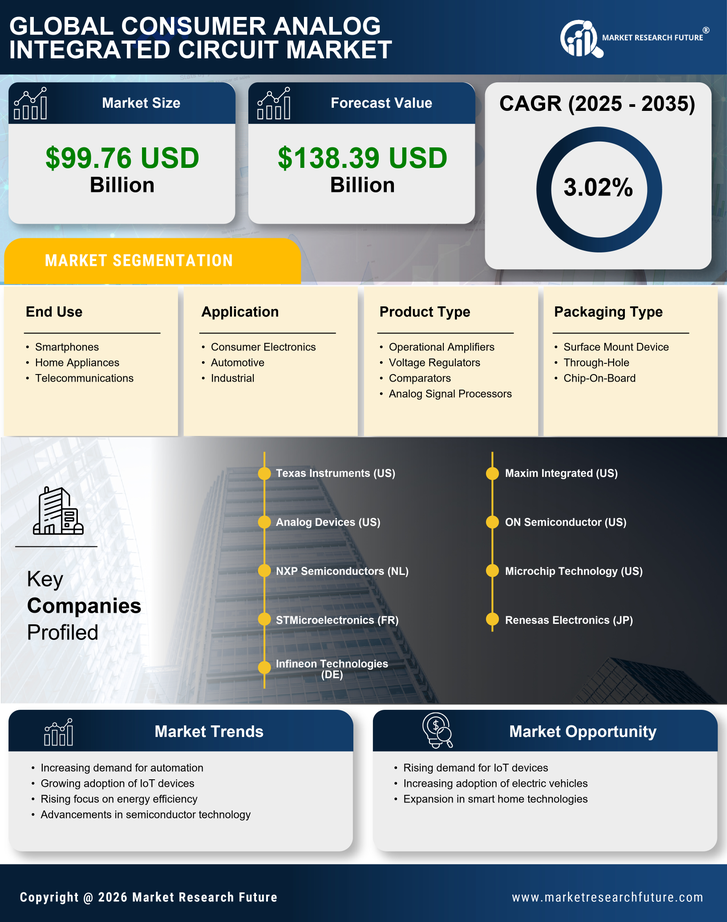
Consumer electronics serve as the primary growth engine for the Consumer Analog Integrated Circuit Market. Analog ICs enable essential functions in devices such as smartphones, laptops, wearables, audio equipment, and smart home appliances. Their ability to process and convert real-world signals into usable data is vital for providing seamless and high-quality user experiences. With the global adoption of connected devices accelerating, the demand for high-performance analog ICs has surged, making them integral to modern electronics.
The proliferation of smartphones has particularly driven analog IC demand. Modern smartphones require multiple analog circuits to manage audio, battery, sensors, and wireless communication. Similarly, wearable devices like smartwatches and fitness trackers rely on analog ICs for heart rate monitoring, motion sensing, and environmental tracking. As these devices become more feature-rich and energy-efficient, the need for advanced analog ICs that combine low power consumption with high accuracy is increasingly critical.
Smart home technologies are further boosting market growth. Devices such as smart thermostats, lighting systems, and security cameras rely on analog ICs to process sensor data and execute real-time control commands. This integration not only enhances user convenience but also increases the demand for ICs capable of handling multiple inputs while consuming minimal power. The ongoing trend toward automation and intelligent control in homes and offices supports long-term market expansion.
Audio and video equipment represent another significant application area. High-fidelity audio systems, headphones, and video processing units require analog ICs for signal amplification, filtering, and conversion. Consumers’ preference for premium sound and visual experiences is prompting manufacturers to adopt analog ICs that deliver superior performance and reliability. Additionally, as home entertainment systems incorporate smart features, analog ICs facilitate seamless interaction between devices and connectivity platforms.
@https://www.marketresearchfuture.com/reports/consumer-analog-integrated-circuit-market-35485
The proliferation of smartphones has particularly driven analog IC demand. Modern smartphones require multiple analog circuits to manage audio, battery, sensors, and wireless communication. Similarly, wearable devices like smartwatches and fitness trackers rely on analog ICs for heart rate monitoring, motion sensing, and environmental tracking. As these devices become more feature-rich and energy-efficient, the need for advanced analog ICs that combine low power consumption with high accuracy is increasingly critical.
Smart home technologies are further boosting market growth. Devices such as smart thermostats, lighting systems, and security cameras rely on analog ICs to process sensor data and execute real-time control commands. This integration not only enhances user convenience but also increases the demand for ICs capable of handling multiple inputs while consuming minimal power. The ongoing trend toward automation and intelligent control in homes and offices supports long-term market expansion.
Audio and video equipment represent another significant application area. High-fidelity audio systems, headphones, and video processing units require analog ICs for signal amplification, filtering, and conversion. Consumers’ preference for premium sound and visual experiences is prompting manufacturers to adopt analog ICs that deliver superior performance and reliability. Additionally, as home entertainment systems incorporate smart features, analog ICs facilitate seamless interaction between devices and connectivity platforms.
@https://www.marketresearchfuture.com/reports/consumer-analog-integrated-circuit-market-35485
Consumer electronics serve as the primary growth engine for the Consumer Analog Integrated Circuit Market. Analog ICs enable essential functions in devices such as smartphones, laptops, wearables, audio equipment, and smart home appliances. Their ability to process and convert real-world signals into usable data is vital for providing seamless and high-quality user experiences. With the global adoption of connected devices accelerating, the demand for high-performance analog ICs has surged, making them integral to modern electronics.
The proliferation of smartphones has particularly driven analog IC demand. Modern smartphones require multiple analog circuits to manage audio, battery, sensors, and wireless communication. Similarly, wearable devices like smartwatches and fitness trackers rely on analog ICs for heart rate monitoring, motion sensing, and environmental tracking. As these devices become more feature-rich and energy-efficient, the need for advanced analog ICs that combine low power consumption with high accuracy is increasingly critical.
Smart home technologies are further boosting market growth. Devices such as smart thermostats, lighting systems, and security cameras rely on analog ICs to process sensor data and execute real-time control commands. This integration not only enhances user convenience but also increases the demand for ICs capable of handling multiple inputs while consuming minimal power. The ongoing trend toward automation and intelligent control in homes and offices supports long-term market expansion.
Audio and video equipment represent another significant application area. High-fidelity audio systems, headphones, and video processing units require analog ICs for signal amplification, filtering, and conversion. Consumers’ preference for premium sound and visual experiences is prompting manufacturers to adopt analog ICs that deliver superior performance and reliability. Additionally, as home entertainment systems incorporate smart features, analog ICs facilitate seamless interaction between devices and connectivity platforms.
@https://www.marketresearchfuture.com/reports/consumer-analog-integrated-circuit-market-35485
0 Kommentare
0 Geteilt
291 Ansichten
0 Bewertungen

 English
 Arabic
 French
 Spanish
 Portuguese
 Turkish
 Dutch
Dutch
 Italiano
 Russian
 Romaian
 Portuguese (Brazil)
 Greek
Greek