
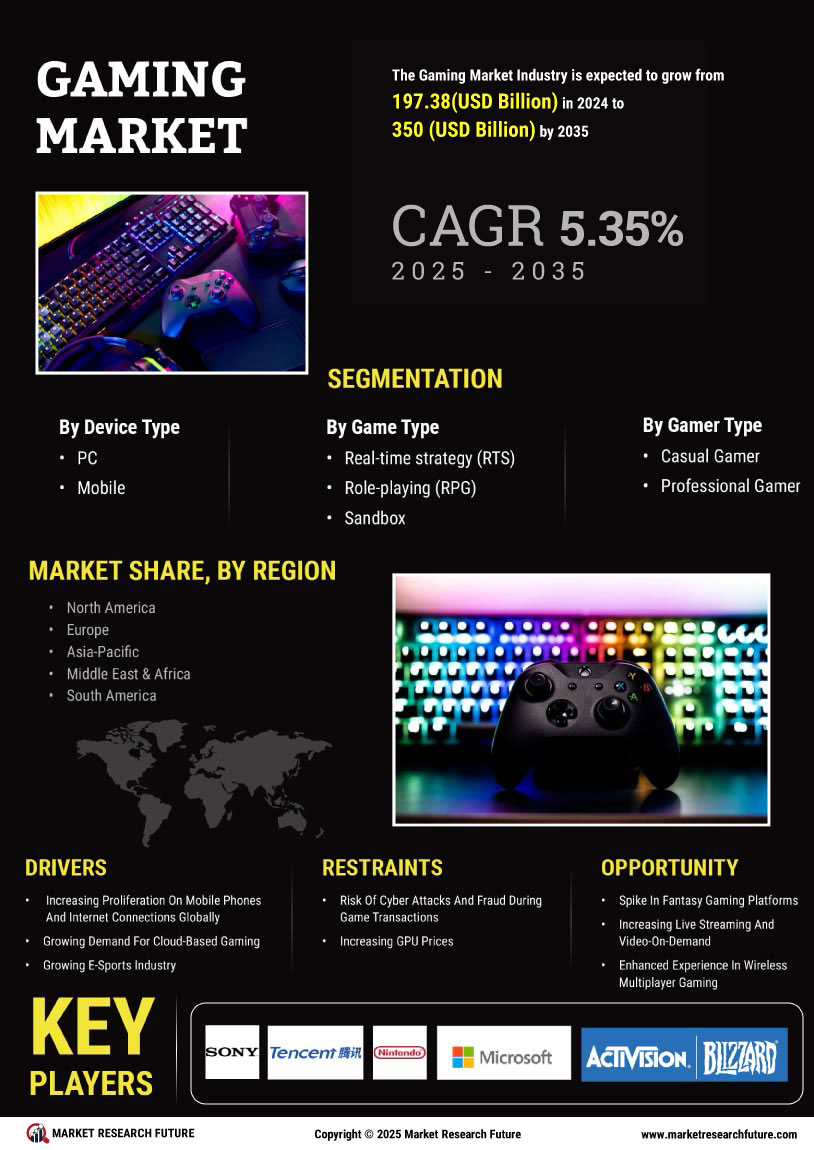
The Gaming Market has been significantly influenced by the rise of mobile gaming, which has transformed the industry landscape. Smartphones and tablets have democratized gaming, enabling millions of users worldwide to engage in gaming activities without the need for consoles or high-end PCs. Mobile games now dominate revenue streams, fueled by innovative monetization models like free-to-play with in-app purchases, subscriptions, and ad-supported content.
Casual gamers, who previously may not have been engaged in traditional gaming, are now a core segment of the market. Popular titles such as Candy Crush, PUBG Mobile, and Genshin Impact exemplify the appeal of mobile gaming, offering short, engaging gameplay sessions suitable for on-the-go entertainment. This has led to higher user acquisition and retention rates, providing developers and publishers with substantial revenue opportunities.
The technological evolution of mobile devices, including enhanced graphics, faster processors, and better connectivity, has allowed developers to create increasingly sophisticated games. Mobile games are now capable of delivering console-quality experiences, which has blurred the lines between mobile and traditional gaming. Cloud gaming services further amplify this trend, enabling players to stream high-end games without hardware constraints.
Emerging markets in Asia, Latin America, and Africa have shown tremendous growth potential due to increasing smartphone penetration and affordable mobile data plans. Countries such as India, Brazil, and Indonesia have become hotspots for mobile gaming, attracting both local and international developers. This growth is complemented by strategic partnerships between telecom companies, game developers, and platform providers to improve accessibility and optimize user experiences.
Monetization strategies play a crucial role in sustaining mobile gaming growth. In addition to microtransactions and in-app purchases, subscription services like Apple Arcade and Google Play Pass provide users with access to premium content for a monthly fee. Advertising within games, including rewarded ads and interstitials, also contributes significantly to revenue generation. Developers increasingly leverage data analytics to understand user behavior, optimize monetization, and enhance engagement.
Social integration within mobile games has also contributed to market expansion. Multiplayer features, online leaderboards, and social media sharing enable players to connect, compete, and collaborate, increasing retention and player loyalty. Games like Among Us and Clash of Clans exemplify how community-driven interactions can amplify popularity and drive continued engagement.
In summary, mobile gaming is a key driver of growth in the gaming market, offering accessible, engaging, and monetizable experiences. Technological advancements, emerging markets, innovative monetization models, and social integration collectively contribute to the expansion of this segment. As mobile devices continue to evolve and consumer expectations rise, mobile gaming is poised to remain a dominant force in the broader gaming ecosystem@https://www.marketresearchfuture.com/reports/gaming-market-10768
Casual gamers, who previously may not have been engaged in traditional gaming, are now a core segment of the market. Popular titles such as Candy Crush, PUBG Mobile, and Genshin Impact exemplify the appeal of mobile gaming, offering short, engaging gameplay sessions suitable for on-the-go entertainment. This has led to higher user acquisition and retention rates, providing developers and publishers with substantial revenue opportunities.
The technological evolution of mobile devices, including enhanced graphics, faster processors, and better connectivity, has allowed developers to create increasingly sophisticated games. Mobile games are now capable of delivering console-quality experiences, which has blurred the lines between mobile and traditional gaming. Cloud gaming services further amplify this trend, enabling players to stream high-end games without hardware constraints.
Emerging markets in Asia, Latin America, and Africa have shown tremendous growth potential due to increasing smartphone penetration and affordable mobile data plans. Countries such as India, Brazil, and Indonesia have become hotspots for mobile gaming, attracting both local and international developers. This growth is complemented by strategic partnerships between telecom companies, game developers, and platform providers to improve accessibility and optimize user experiences.
Monetization strategies play a crucial role in sustaining mobile gaming growth. In addition to microtransactions and in-app purchases, subscription services like Apple Arcade and Google Play Pass provide users with access to premium content for a monthly fee. Advertising within games, including rewarded ads and interstitials, also contributes significantly to revenue generation. Developers increasingly leverage data analytics to understand user behavior, optimize monetization, and enhance engagement.
Social integration within mobile games has also contributed to market expansion. Multiplayer features, online leaderboards, and social media sharing enable players to connect, compete, and collaborate, increasing retention and player loyalty. Games like Among Us and Clash of Clans exemplify how community-driven interactions can amplify popularity and drive continued engagement.
In summary, mobile gaming is a key driver of growth in the gaming market, offering accessible, engaging, and monetizable experiences. Technological advancements, emerging markets, innovative monetization models, and social integration collectively contribute to the expansion of this segment. As mobile devices continue to evolve and consumer expectations rise, mobile gaming is poised to remain a dominant force in the broader gaming ecosystem@https://www.marketresearchfuture.com/reports/gaming-market-10768
The Gaming Market has been significantly influenced by the rise of mobile gaming, which has transformed the industry landscape. Smartphones and tablets have democratized gaming, enabling millions of users worldwide to engage in gaming activities without the need for consoles or high-end PCs. Mobile games now dominate revenue streams, fueled by innovative monetization models like free-to-play with in-app purchases, subscriptions, and ad-supported content.
Casual gamers, who previously may not have been engaged in traditional gaming, are now a core segment of the market. Popular titles such as Candy Crush, PUBG Mobile, and Genshin Impact exemplify the appeal of mobile gaming, offering short, engaging gameplay sessions suitable for on-the-go entertainment. This has led to higher user acquisition and retention rates, providing developers and publishers with substantial revenue opportunities.
The technological evolution of mobile devices, including enhanced graphics, faster processors, and better connectivity, has allowed developers to create increasingly sophisticated games. Mobile games are now capable of delivering console-quality experiences, which has blurred the lines between mobile and traditional gaming. Cloud gaming services further amplify this trend, enabling players to stream high-end games without hardware constraints.
Emerging markets in Asia, Latin America, and Africa have shown tremendous growth potential due to increasing smartphone penetration and affordable mobile data plans. Countries such as India, Brazil, and Indonesia have become hotspots for mobile gaming, attracting both local and international developers. This growth is complemented by strategic partnerships between telecom companies, game developers, and platform providers to improve accessibility and optimize user experiences.
Monetization strategies play a crucial role in sustaining mobile gaming growth. In addition to microtransactions and in-app purchases, subscription services like Apple Arcade and Google Play Pass provide users with access to premium content for a monthly fee. Advertising within games, including rewarded ads and interstitials, also contributes significantly to revenue generation. Developers increasingly leverage data analytics to understand user behavior, optimize monetization, and enhance engagement.
Social integration within mobile games has also contributed to market expansion. Multiplayer features, online leaderboards, and social media sharing enable players to connect, compete, and collaborate, increasing retention and player loyalty. Games like Among Us and Clash of Clans exemplify how community-driven interactions can amplify popularity and drive continued engagement.
In summary, mobile gaming is a key driver of growth in the gaming market, offering accessible, engaging, and monetizable experiences. Technological advancements, emerging markets, innovative monetization models, and social integration collectively contribute to the expansion of this segment. As mobile devices continue to evolve and consumer expectations rise, mobile gaming is poised to remain a dominant force in the broader gaming ecosystem@https://www.marketresearchfuture.com/reports/gaming-market-10768
0 Comentários
0 Compartilhamentos
435 Visualizações
0 Anterior

 English
 Arabic
 French
 Spanish
 Portuguese
 Deutsch
 Turkish
 Dutch
Dutch
 Italiano
 Russian
 Romaian
 Greek
Greek