
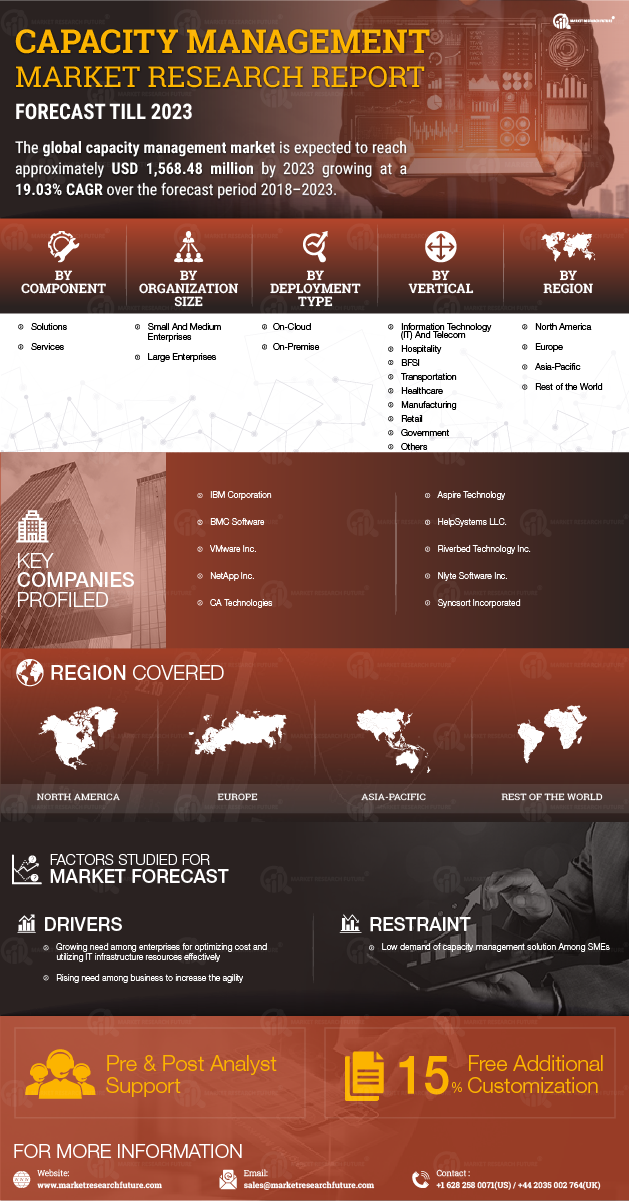
The Capacity Management Market is evolving as enterprises shift towards digital-first strategies, where optimal utilization of IT resources is critical for operational success. Organizations are increasingly recognizing the value of predictive capacity planning, real-time monitoring, and data-driven decision-making in avoiding service disruptions and optimizing performance. By leveraging these solutions, businesses can balance workload demands with resource availability, ultimately enhancing productivity and reducing costs.
The demand for cloud computing, virtualization, and hybrid IT environments has transformed capacity management from a reactive process into a proactive, intelligence-driven approach. Modern capacity management solutions leverage AI and machine learning to analyze historical data, predict future requirements, and generate recommendations for scaling IT infrastructure. This predictive capability allows IT teams to prevent performance issues, minimize downtime, and allocate resources efficiently, which is particularly critical in high-demand industries such as finance, healthcare, and e-commerce.
Organizations are increasingly focusing on integrating capacity management with IT operations analytics (ITOA) and IT service management (ITSM) tools. Such integration ensures a holistic view of resource utilization, enabling better alignment of IT resources with business priorities. Automated alerts, performance dashboards, and usage trend analysis provide actionable insights for IT managers, ensuring that infrastructure is neither underutilized nor overprovisioned. This level of visibility also helps reduce operational expenditures and optimize capital investment in IT assets.
Cloud-based capacity management platforms are emerging as a preferred choice due to their flexibility, scalability, and ease of deployment. Enterprises benefit from real-time analytics, automated reporting, and seamless integration with cloud service providers. Additionally, hybrid models enable organizations to manage workloads across on-premises and cloud environments, maintaining optimal performance while controlling costs. The growing reliance on digital services and mobile applications has further accelerated the adoption of these solutions.
Geographically, North America remains a key market due to technological advancement, early adoption of cloud services, and the presence of major IT solution providers. Europe follows with steady adoption driven by regulatory compliance and operational efficiency goals. The Asia-Pacific region is witnessing rapid growth, spurred by digital transformation initiatives, increased data center investments, and the rise of small and medium-sized enterprises embracing capacity management solutions.
Market challenges include the complexity of deployment, high initial investment, and the need for skilled personnel to interpret analytics effectively. Vendors are addressing these issues by offering AI-enabled, cloud-based solutions with simplified interfaces and automated capabilities. The trend towards predictive and automated capacity management is expected to further drive market growth, as businesses increasingly seek solutions that reduce downtime, optimize performance, and deliver measurable ROI.
As digital infrastructure continues to expand and enterprises prioritize efficiency, the capacity management market is set to experience significant growth. Organizations adopting these solutions will gain a competitive edge through improved operational efficiency, reduced costs, and enhanced IT service quality, paving the way for a more agile and resilient business environment
@https://www.marketresearchfuture.com/reports/capacity-management-market-6309
The demand for cloud computing, virtualization, and hybrid IT environments has transformed capacity management from a reactive process into a proactive, intelligence-driven approach. Modern capacity management solutions leverage AI and machine learning to analyze historical data, predict future requirements, and generate recommendations for scaling IT infrastructure. This predictive capability allows IT teams to prevent performance issues, minimize downtime, and allocate resources efficiently, which is particularly critical in high-demand industries such as finance, healthcare, and e-commerce.
Organizations are increasingly focusing on integrating capacity management with IT operations analytics (ITOA) and IT service management (ITSM) tools. Such integration ensures a holistic view of resource utilization, enabling better alignment of IT resources with business priorities. Automated alerts, performance dashboards, and usage trend analysis provide actionable insights for IT managers, ensuring that infrastructure is neither underutilized nor overprovisioned. This level of visibility also helps reduce operational expenditures and optimize capital investment in IT assets.
Cloud-based capacity management platforms are emerging as a preferred choice due to their flexibility, scalability, and ease of deployment. Enterprises benefit from real-time analytics, automated reporting, and seamless integration with cloud service providers. Additionally, hybrid models enable organizations to manage workloads across on-premises and cloud environments, maintaining optimal performance while controlling costs. The growing reliance on digital services and mobile applications has further accelerated the adoption of these solutions.
Geographically, North America remains a key market due to technological advancement, early adoption of cloud services, and the presence of major IT solution providers. Europe follows with steady adoption driven by regulatory compliance and operational efficiency goals. The Asia-Pacific region is witnessing rapid growth, spurred by digital transformation initiatives, increased data center investments, and the rise of small and medium-sized enterprises embracing capacity management solutions.
Market challenges include the complexity of deployment, high initial investment, and the need for skilled personnel to interpret analytics effectively. Vendors are addressing these issues by offering AI-enabled, cloud-based solutions with simplified interfaces and automated capabilities. The trend towards predictive and automated capacity management is expected to further drive market growth, as businesses increasingly seek solutions that reduce downtime, optimize performance, and deliver measurable ROI.
As digital infrastructure continues to expand and enterprises prioritize efficiency, the capacity management market is set to experience significant growth. Organizations adopting these solutions will gain a competitive edge through improved operational efficiency, reduced costs, and enhanced IT service quality, paving the way for a more agile and resilient business environment
@https://www.marketresearchfuture.com/reports/capacity-management-market-6309
The Capacity Management Market is evolving as enterprises shift towards digital-first strategies, where optimal utilization of IT resources is critical for operational success. Organizations are increasingly recognizing the value of predictive capacity planning, real-time monitoring, and data-driven decision-making in avoiding service disruptions and optimizing performance. By leveraging these solutions, businesses can balance workload demands with resource availability, ultimately enhancing productivity and reducing costs.
The demand for cloud computing, virtualization, and hybrid IT environments has transformed capacity management from a reactive process into a proactive, intelligence-driven approach. Modern capacity management solutions leverage AI and machine learning to analyze historical data, predict future requirements, and generate recommendations for scaling IT infrastructure. This predictive capability allows IT teams to prevent performance issues, minimize downtime, and allocate resources efficiently, which is particularly critical in high-demand industries such as finance, healthcare, and e-commerce.
Organizations are increasingly focusing on integrating capacity management with IT operations analytics (ITOA) and IT service management (ITSM) tools. Such integration ensures a holistic view of resource utilization, enabling better alignment of IT resources with business priorities. Automated alerts, performance dashboards, and usage trend analysis provide actionable insights for IT managers, ensuring that infrastructure is neither underutilized nor overprovisioned. This level of visibility also helps reduce operational expenditures and optimize capital investment in IT assets.
Cloud-based capacity management platforms are emerging as a preferred choice due to their flexibility, scalability, and ease of deployment. Enterprises benefit from real-time analytics, automated reporting, and seamless integration with cloud service providers. Additionally, hybrid models enable organizations to manage workloads across on-premises and cloud environments, maintaining optimal performance while controlling costs. The growing reliance on digital services and mobile applications has further accelerated the adoption of these solutions.
Geographically, North America remains a key market due to technological advancement, early adoption of cloud services, and the presence of major IT solution providers. Europe follows with steady adoption driven by regulatory compliance and operational efficiency goals. The Asia-Pacific region is witnessing rapid growth, spurred by digital transformation initiatives, increased data center investments, and the rise of small and medium-sized enterprises embracing capacity management solutions.
Market challenges include the complexity of deployment, high initial investment, and the need for skilled personnel to interpret analytics effectively. Vendors are addressing these issues by offering AI-enabled, cloud-based solutions with simplified interfaces and automated capabilities. The trend towards predictive and automated capacity management is expected to further drive market growth, as businesses increasingly seek solutions that reduce downtime, optimize performance, and deliver measurable ROI.
As digital infrastructure continues to expand and enterprises prioritize efficiency, the capacity management market is set to experience significant growth. Organizations adopting these solutions will gain a competitive edge through improved operational efficiency, reduced costs, and enhanced IT service quality, paving the way for a more agile and resilient business environment
@https://www.marketresearchfuture.com/reports/capacity-management-market-6309
0 Commentarii
0 Distribuiri
417 Views
0 previzualizare

 English
 Arabic
 French
 Spanish
 Portuguese
 Deutsch
 Turkish
 Dutch
Dutch
 Italiano
 Russian
 Portuguese (Brazil)
 Greek
Greek