
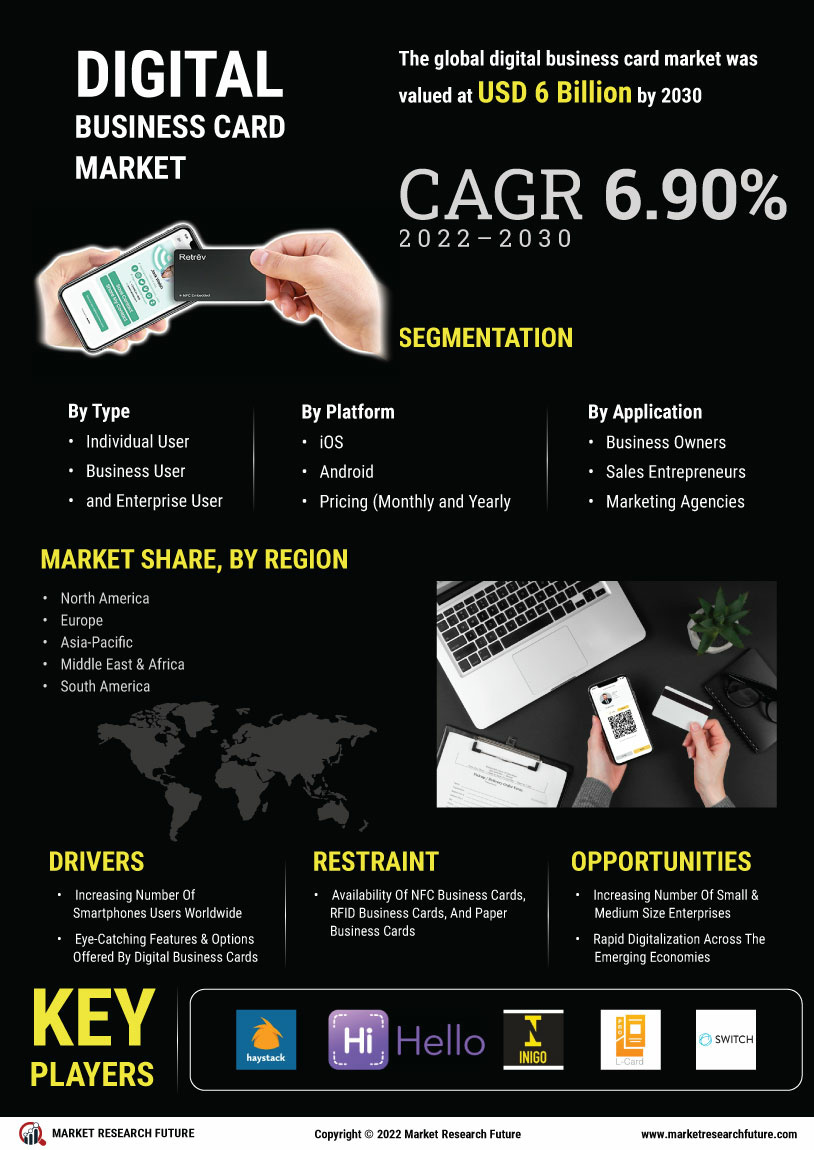
The Digital Business Card Market is gaining strong global attention as businesses and professionals increasingly shift from traditional paper-based networking to smart, sustainable, and technology-driven solutions. Digital business cards are rapidly becoming a preferred alternative because they offer convenience, cost-effectiveness, and instant sharing through smartphones, QR codes, NFC-enabled devices, email signatures, and social media platforms.
The global adoption of digital business cards is largely influenced by the increasing use of smartphones and the widespread expansion of internet connectivity. Professionals are now more connected than ever, and networking has become a daily activity rather than something limited to formal meetings. Digital cards allow individuals to share contact details instantly while also enabling recipients to save information without manual typing. This reduces errors, improves accuracy, and enhances professional communication efficiency.
A major benefit of digital business cards is their ability to store more than basic information. Unlike traditional cards that only provide a name, company, phone number, and email, digital formats can include website links, portfolios, videos, product catalogs, location maps, social media handles, and even appointment scheduling options. This flexibility makes them especially valuable for entrepreneurs, sales professionals, marketing executives, consultants, freelancers, and corporate leaders.
The market is also being driven by rising environmental concerns. Companies are actively reducing paper consumption to meet sustainability goals. Printing thousands of paper business cards annually leads to waste, especially when employees change roles or contact details. Digital solutions solve this issue by allowing users to update their information instantly without the need for reprinting. This supports eco-friendly branding and aligns with corporate social responsibility strategies.
Another important aspect supporting growth is the increasing role of digital networking platforms. Virtual events, online conferences, webinars, and hybrid business meetings have become mainstream. In such environments, exchanging physical business cards is not possible, and digital business cards provide an effective replacement. They allow professionals to connect instantly, even when interacting remotely, which has made them a critical tool for modern business culture
@https://www.marketresearchfuture.com/reports/digital-business-card-market-10696
The global adoption of digital business cards is largely influenced by the increasing use of smartphones and the widespread expansion of internet connectivity. Professionals are now more connected than ever, and networking has become a daily activity rather than something limited to formal meetings. Digital cards allow individuals to share contact details instantly while also enabling recipients to save information without manual typing. This reduces errors, improves accuracy, and enhances professional communication efficiency.
A major benefit of digital business cards is their ability to store more than basic information. Unlike traditional cards that only provide a name, company, phone number, and email, digital formats can include website links, portfolios, videos, product catalogs, location maps, social media handles, and even appointment scheduling options. This flexibility makes them especially valuable for entrepreneurs, sales professionals, marketing executives, consultants, freelancers, and corporate leaders.
The market is also being driven by rising environmental concerns. Companies are actively reducing paper consumption to meet sustainability goals. Printing thousands of paper business cards annually leads to waste, especially when employees change roles or contact details. Digital solutions solve this issue by allowing users to update their information instantly without the need for reprinting. This supports eco-friendly branding and aligns with corporate social responsibility strategies.
Another important aspect supporting growth is the increasing role of digital networking platforms. Virtual events, online conferences, webinars, and hybrid business meetings have become mainstream. In such environments, exchanging physical business cards is not possible, and digital business cards provide an effective replacement. They allow professionals to connect instantly, even when interacting remotely, which has made them a critical tool for modern business culture
@https://www.marketresearchfuture.com/reports/digital-business-card-market-10696
The Digital Business Card Market is gaining strong global attention as businesses and professionals increasingly shift from traditional paper-based networking to smart, sustainable, and technology-driven solutions. Digital business cards are rapidly becoming a preferred alternative because they offer convenience, cost-effectiveness, and instant sharing through smartphones, QR codes, NFC-enabled devices, email signatures, and social media platforms.
The global adoption of digital business cards is largely influenced by the increasing use of smartphones and the widespread expansion of internet connectivity. Professionals are now more connected than ever, and networking has become a daily activity rather than something limited to formal meetings. Digital cards allow individuals to share contact details instantly while also enabling recipients to save information without manual typing. This reduces errors, improves accuracy, and enhances professional communication efficiency.
A major benefit of digital business cards is their ability to store more than basic information. Unlike traditional cards that only provide a name, company, phone number, and email, digital formats can include website links, portfolios, videos, product catalogs, location maps, social media handles, and even appointment scheduling options. This flexibility makes them especially valuable for entrepreneurs, sales professionals, marketing executives, consultants, freelancers, and corporate leaders.
The market is also being driven by rising environmental concerns. Companies are actively reducing paper consumption to meet sustainability goals. Printing thousands of paper business cards annually leads to waste, especially when employees change roles or contact details. Digital solutions solve this issue by allowing users to update their information instantly without the need for reprinting. This supports eco-friendly branding and aligns with corporate social responsibility strategies.
Another important aspect supporting growth is the increasing role of digital networking platforms. Virtual events, online conferences, webinars, and hybrid business meetings have become mainstream. In such environments, exchanging physical business cards is not possible, and digital business cards provide an effective replacement. They allow professionals to connect instantly, even when interacting remotely, which has made them a critical tool for modern business culture
@https://www.marketresearchfuture.com/reports/digital-business-card-market-10696
0 Commentaires
0 Parts
446 Vue
0 Aperçu

 English
 Arabic
 Spanish
 Portuguese
 Deutsch
 Turkish
 Dutch
Dutch
 Italiano
 Russian
 Romaian
 Portuguese (Brazil)
 Greek
Greek