
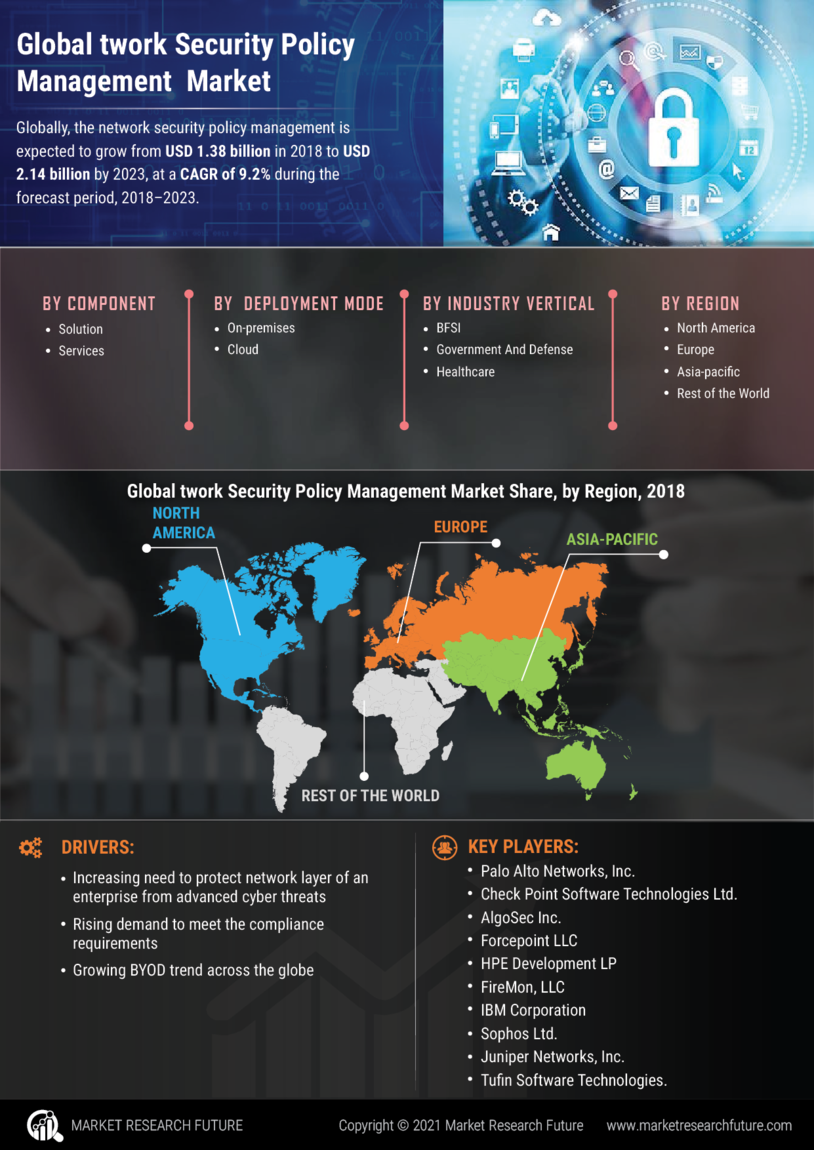
The Network Security Policy Management Market is expanding rapidly due to the growing need for organizations to secure complex network environments. Enterprises today manage a large number of security devices such as firewalls, intrusion prevention systems, VPN gateways, and cloud security tools. With this expansion, managing policies manually becomes time-consuming and increases the risk of errors. Security policy management solutions provide centralized visibility and control, ensuring that rules are enforced consistently across the entire network infrastructure.
One of the biggest challenges in cybersecurity is misconfiguration. Many data breaches occur because of outdated rules, open ports, or incorrect firewall policies. Policy management tools help prevent such incidents by automating rule validation and detecting conflicts. These solutions can scan policies and identify duplicate rules, unused configurations, and risky permissions. This improves both security and operational efficiency, allowing IT teams to focus on strategic tasks rather than repetitive manual updates.
Cloud migration is a major factor contributing to market growth. Businesses are shifting workloads to public and private clouds, creating hybrid environments that require new security approaches. Traditional security policies designed for on-premise networks may not be suitable for cloud workloads. Network security policy management platforms support policy enforcement across cloud platforms such as AWS, Azure, and Google Cloud, ensuring consistent protection across all environments.
The increasing adoption of remote work is another major driver. Remote employees connect to enterprise systems through VPNs and cloud applications, increasing exposure to cyber threats. Policy management solutions enable enterprises to enforce access control rules and secure remote connectivity. They also support role-based access control, ensuring that users only access resources necessary for their tasks.
Enterprises are also adopting policy management solutions to support business continuity. Cyberattacks such as ransomware can disrupt business operations, causing financial losses and reputational damage. With proper policy management, organizations can reduce the attack surface and quickly respond to threats. Some platforms also integrate with incident response systems, allowing security teams to apply policy changes immediately when an attack is detected.
Compliance management is another key application area. Regulatory requirements such as GDPR, HIPAA, PCI-DSS, and ISO standards require organizations to maintain strong access controls and demonstrate audit readiness. Policy management solutions provide reporting tools and compliance checks, making audits faster and easier. This is particularly important for industries handling sensitive data such as healthcare and finance.
The competitive landscape of the market includes major cybersecurity vendors and specialized policy management solution providers. Vendors are enhancing their offerings by integrating AI-driven analytics, automation, and advanced reporting features. This is improving the accuracy and speed of policy enforcement.
@https://www.marketresearchfuture.com/reports/network-security-policy-management-market-7038
One of the biggest challenges in cybersecurity is misconfiguration. Many data breaches occur because of outdated rules, open ports, or incorrect firewall policies. Policy management tools help prevent such incidents by automating rule validation and detecting conflicts. These solutions can scan policies and identify duplicate rules, unused configurations, and risky permissions. This improves both security and operational efficiency, allowing IT teams to focus on strategic tasks rather than repetitive manual updates.
Cloud migration is a major factor contributing to market growth. Businesses are shifting workloads to public and private clouds, creating hybrid environments that require new security approaches. Traditional security policies designed for on-premise networks may not be suitable for cloud workloads. Network security policy management platforms support policy enforcement across cloud platforms such as AWS, Azure, and Google Cloud, ensuring consistent protection across all environments.
The increasing adoption of remote work is another major driver. Remote employees connect to enterprise systems through VPNs and cloud applications, increasing exposure to cyber threats. Policy management solutions enable enterprises to enforce access control rules and secure remote connectivity. They also support role-based access control, ensuring that users only access resources necessary for their tasks.
Enterprises are also adopting policy management solutions to support business continuity. Cyberattacks such as ransomware can disrupt business operations, causing financial losses and reputational damage. With proper policy management, organizations can reduce the attack surface and quickly respond to threats. Some platforms also integrate with incident response systems, allowing security teams to apply policy changes immediately when an attack is detected.
Compliance management is another key application area. Regulatory requirements such as GDPR, HIPAA, PCI-DSS, and ISO standards require organizations to maintain strong access controls and demonstrate audit readiness. Policy management solutions provide reporting tools and compliance checks, making audits faster and easier. This is particularly important for industries handling sensitive data such as healthcare and finance.
The competitive landscape of the market includes major cybersecurity vendors and specialized policy management solution providers. Vendors are enhancing their offerings by integrating AI-driven analytics, automation, and advanced reporting features. This is improving the accuracy and speed of policy enforcement.
@https://www.marketresearchfuture.com/reports/network-security-policy-management-market-7038
The Network Security Policy Management Market is expanding rapidly due to the growing need for organizations to secure complex network environments. Enterprises today manage a large number of security devices such as firewalls, intrusion prevention systems, VPN gateways, and cloud security tools. With this expansion, managing policies manually becomes time-consuming and increases the risk of errors. Security policy management solutions provide centralized visibility and control, ensuring that rules are enforced consistently across the entire network infrastructure.
One of the biggest challenges in cybersecurity is misconfiguration. Many data breaches occur because of outdated rules, open ports, or incorrect firewall policies. Policy management tools help prevent such incidents by automating rule validation and detecting conflicts. These solutions can scan policies and identify duplicate rules, unused configurations, and risky permissions. This improves both security and operational efficiency, allowing IT teams to focus on strategic tasks rather than repetitive manual updates.
Cloud migration is a major factor contributing to market growth. Businesses are shifting workloads to public and private clouds, creating hybrid environments that require new security approaches. Traditional security policies designed for on-premise networks may not be suitable for cloud workloads. Network security policy management platforms support policy enforcement across cloud platforms such as AWS, Azure, and Google Cloud, ensuring consistent protection across all environments.
The increasing adoption of remote work is another major driver. Remote employees connect to enterprise systems through VPNs and cloud applications, increasing exposure to cyber threats. Policy management solutions enable enterprises to enforce access control rules and secure remote connectivity. They also support role-based access control, ensuring that users only access resources necessary for their tasks.
Enterprises are also adopting policy management solutions to support business continuity. Cyberattacks such as ransomware can disrupt business operations, causing financial losses and reputational damage. With proper policy management, organizations can reduce the attack surface and quickly respond to threats. Some platforms also integrate with incident response systems, allowing security teams to apply policy changes immediately when an attack is detected.
Compliance management is another key application area. Regulatory requirements such as GDPR, HIPAA, PCI-DSS, and ISO standards require organizations to maintain strong access controls and demonstrate audit readiness. Policy management solutions provide reporting tools and compliance checks, making audits faster and easier. This is particularly important for industries handling sensitive data such as healthcare and finance.
The competitive landscape of the market includes major cybersecurity vendors and specialized policy management solution providers. Vendors are enhancing their offerings by integrating AI-driven analytics, automation, and advanced reporting features. This is improving the accuracy and speed of policy enforcement.
@https://www.marketresearchfuture.com/reports/network-security-policy-management-market-7038
0 Kommentare
0 Geteilt
450 Ansichten
0 Bewertungen

 English
 Arabic
 French
 Spanish
 Portuguese
 Turkish
 Dutch
Dutch
 Italiano
 Russian
 Romaian
 Portuguese (Brazil)
 Greek
Greek