
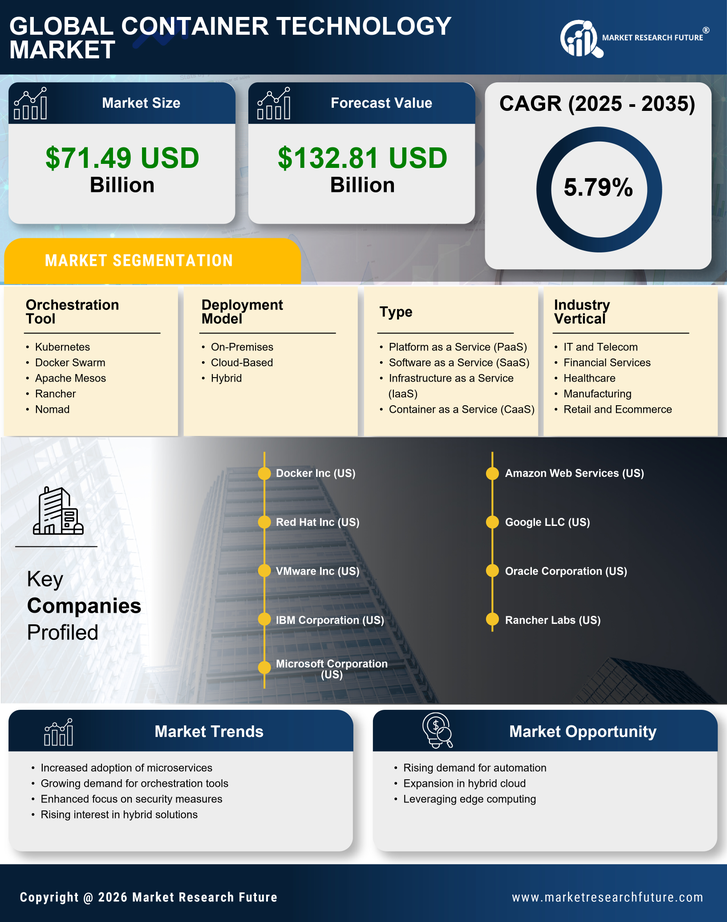
The Container Technology Market has emerged as a cornerstone of enterprise IT infrastructure, enabling organizations to build, deploy, and manage applications efficiently. Containerization packages software along with its dependencies into a single, portable unit, ensuring consistency across environments. The surge in digital transformation initiatives and cloud adoption has amplified the demand for container technology. Enterprises are increasingly leveraging containerized environments to streamline operations, reduce infrastructure costs, and accelerate software delivery. This technology empowers development teams to focus on coding and innovation rather than dealing with environment inconsistencies, driving agility across the software development lifecycle.
A significant factor accelerating market growth is the adoption of microservices architecture. Unlike traditional monolithic applications, microservices break down complex applications into smaller, independent components that can be deployed and scaled individually. Containers provide the ideal environment for microservices, offering isolation, portability, and rapid deployment. Organizations leveraging microservices and containers together can achieve faster release cycles, enhanced fault tolerance, and better resource utilization. This combination allows enterprises to innovate more quickly and respond to changing business requirements with agility.
Cloud-native adoption is another major driver for container technology. As organizations shift workloads to public, private, or hybrid cloud platforms, the need for portable and consistent deployment solutions becomes critical. Containers abstract the underlying infrastructure, enabling workloads to run seamlessly across multiple cloud environments. Major cloud providers such as AWS, Microsoft Azure, and Google Cloud offer integrated container services that simplify management and orchestration, making it easier for enterprises to adopt container-based solutions without extensive overhead.
Security concerns, once a barrier to container adoption, are being addressed by modern container security tools. Solutions provide runtime protection, vulnerability scanning, and compliance management to secure containerized applications. Enterprises in regulated sectors like finance, healthcare, and government increasingly rely on containers for secure and auditable deployments. By embedding security into the container lifecycle, organizations can minimize risks and ensure compliance while benefiting from the agility and portability that containers provide.
The market is also seeing strong adoption in edge computing scenarios. As more data is processed closer to end-users, containers provide lightweight, portable solutions that can run on limited-resource edge devices. This capability is critical for applications in IoT, real-time analytics, and AI-powered services where latency and bandwidth optimization are essential. Containerized edge applications maintain the same portability and efficiency as their cloud counterparts, allowing organizations to deploy solutions across diverse environments without reconfiguration
@https://www.marketresearchfuture.com/reports/container-technology-market-35732
A significant factor accelerating market growth is the adoption of microservices architecture. Unlike traditional monolithic applications, microservices break down complex applications into smaller, independent components that can be deployed and scaled individually. Containers provide the ideal environment for microservices, offering isolation, portability, and rapid deployment. Organizations leveraging microservices and containers together can achieve faster release cycles, enhanced fault tolerance, and better resource utilization. This combination allows enterprises to innovate more quickly and respond to changing business requirements with agility.
Cloud-native adoption is another major driver for container technology. As organizations shift workloads to public, private, or hybrid cloud platforms, the need for portable and consistent deployment solutions becomes critical. Containers abstract the underlying infrastructure, enabling workloads to run seamlessly across multiple cloud environments. Major cloud providers such as AWS, Microsoft Azure, and Google Cloud offer integrated container services that simplify management and orchestration, making it easier for enterprises to adopt container-based solutions without extensive overhead.
Security concerns, once a barrier to container adoption, are being addressed by modern container security tools. Solutions provide runtime protection, vulnerability scanning, and compliance management to secure containerized applications. Enterprises in regulated sectors like finance, healthcare, and government increasingly rely on containers for secure and auditable deployments. By embedding security into the container lifecycle, organizations can minimize risks and ensure compliance while benefiting from the agility and portability that containers provide.
The market is also seeing strong adoption in edge computing scenarios. As more data is processed closer to end-users, containers provide lightweight, portable solutions that can run on limited-resource edge devices. This capability is critical for applications in IoT, real-time analytics, and AI-powered services where latency and bandwidth optimization are essential. Containerized edge applications maintain the same portability and efficiency as their cloud counterparts, allowing organizations to deploy solutions across diverse environments without reconfiguration
@https://www.marketresearchfuture.com/reports/container-technology-market-35732
The Container Technology Market has emerged as a cornerstone of enterprise IT infrastructure, enabling organizations to build, deploy, and manage applications efficiently. Containerization packages software along with its dependencies into a single, portable unit, ensuring consistency across environments. The surge in digital transformation initiatives and cloud adoption has amplified the demand for container technology. Enterprises are increasingly leveraging containerized environments to streamline operations, reduce infrastructure costs, and accelerate software delivery. This technology empowers development teams to focus on coding and innovation rather than dealing with environment inconsistencies, driving agility across the software development lifecycle.
A significant factor accelerating market growth is the adoption of microservices architecture. Unlike traditional monolithic applications, microservices break down complex applications into smaller, independent components that can be deployed and scaled individually. Containers provide the ideal environment for microservices, offering isolation, portability, and rapid deployment. Organizations leveraging microservices and containers together can achieve faster release cycles, enhanced fault tolerance, and better resource utilization. This combination allows enterprises to innovate more quickly and respond to changing business requirements with agility.
Cloud-native adoption is another major driver for container technology. As organizations shift workloads to public, private, or hybrid cloud platforms, the need for portable and consistent deployment solutions becomes critical. Containers abstract the underlying infrastructure, enabling workloads to run seamlessly across multiple cloud environments. Major cloud providers such as AWS, Microsoft Azure, and Google Cloud offer integrated container services that simplify management and orchestration, making it easier for enterprises to adopt container-based solutions without extensive overhead.
Security concerns, once a barrier to container adoption, are being addressed by modern container security tools. Solutions provide runtime protection, vulnerability scanning, and compliance management to secure containerized applications. Enterprises in regulated sectors like finance, healthcare, and government increasingly rely on containers for secure and auditable deployments. By embedding security into the container lifecycle, organizations can minimize risks and ensure compliance while benefiting from the agility and portability that containers provide.
The market is also seeing strong adoption in edge computing scenarios. As more data is processed closer to end-users, containers provide lightweight, portable solutions that can run on limited-resource edge devices. This capability is critical for applications in IoT, real-time analytics, and AI-powered services where latency and bandwidth optimization are essential. Containerized edge applications maintain the same portability and efficiency as their cloud counterparts, allowing organizations to deploy solutions across diverse environments without reconfiguration
@https://www.marketresearchfuture.com/reports/container-technology-market-35732
0 Σχόλια
0 Μοιράστηκε
390 Views
0 Προεπισκόπηση

 English
 Arabic
 French
 Spanish
 Portuguese
 Deutsch
 Turkish
 Dutch
Dutch
 Italiano
 Russian
 Romaian
 Portuguese (Brazil)